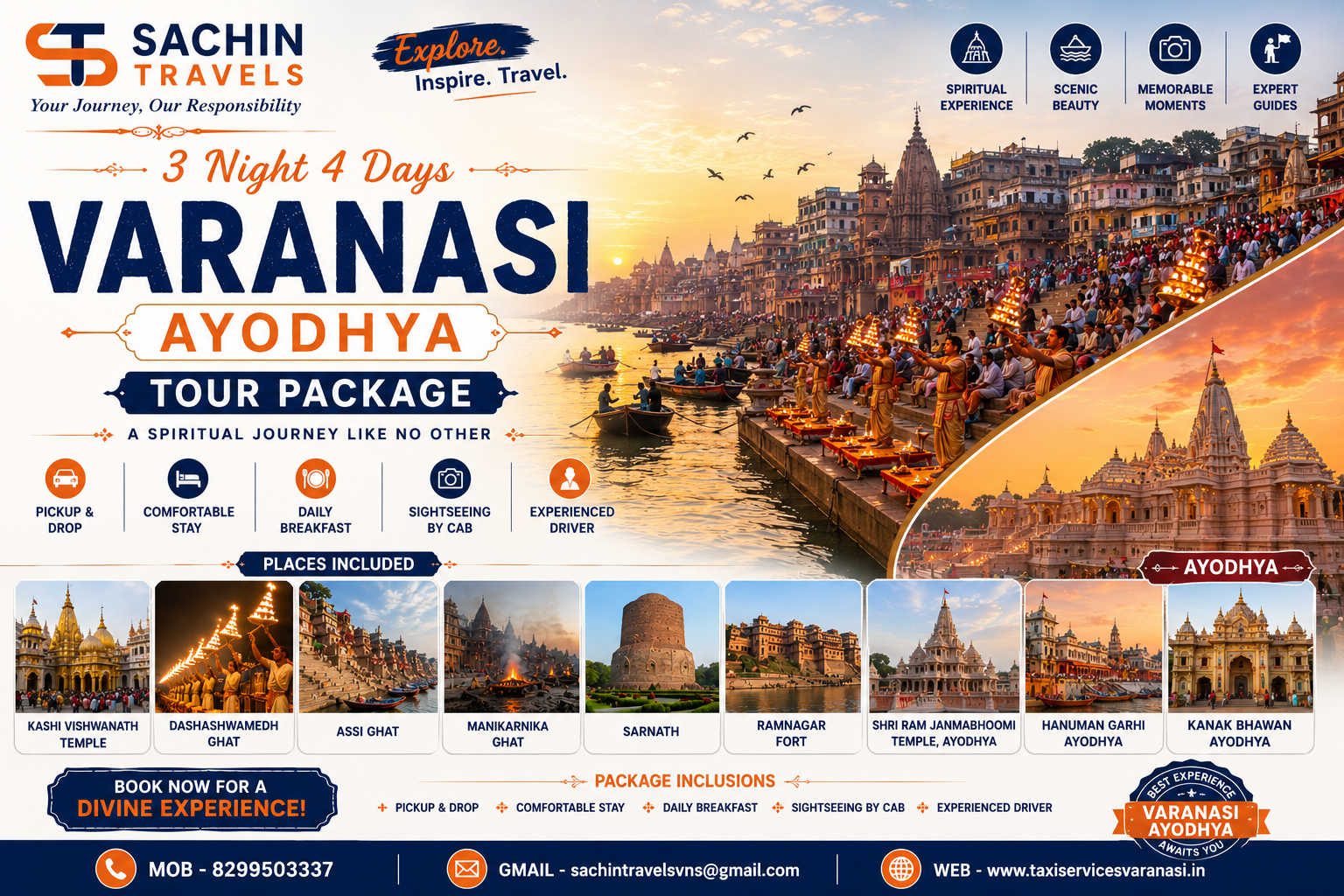
Taxi Service in Varanasi: The Complete 2026 Guide
Taxi Service in Varanasi: The Complete 2026 Guide to Fares, Routes, Ola/Uber & Booking
Last updated: August 2026
If you’ve searched “taxi service in Varanasi,” you’ve probably already noticed the problem: every page quotes a slightly different fare, nobody agrees on whether Ola and Uber actually work here, and none of them explain why your driver just refused to take you to your hotel near the ghats. This guide answers all of it in one place — airport transfers, local sightseeing, every outstation route travelers actually ask about, the old-city geography that determines whether a car can reach you at all, and exactly how fares are calculated so nothing feels like a surprise when you arrive.
Everything here reflects how taxi service in Varanasi — also searched as car service in Varanasi, cab service in Varanasi, and taxi service in Banaras — actually works on the ground, not a generic template.
What’s in This Guide
- The Types of Taxi Service in Varanasi
- Varanasi Airport Taxi — Fares & What to Expect
- Local Sightseeing & Hourly Packages
- Choosing a Vehicle — Sedan, Innova, Tempo Traveller, Urbania
- Ola and Uber in Varanasi — What Works, What Doesn’t
- Varanasi’s Old City — Where Vehicles Genuinely Can’t Go
- Varanasi’s Railway Stations — Junction, Cantt & the Others
- Outstation Taxi from Varanasi — Every Route Compared
- How Outstation Fares Are Actually Calculated
- Best Time to Book — Season & Festival Calendar
- How Booking Works, Step by Step
- Safety & What to Verify Before You Book
- What Travelers Say
- Frequently Asked Questions
The Types of Taxi Service in Varanasi
Nearly every search for taxi service in Varanasi — or the same thing phrased as car service in Varanasi, local taxi service in Varanasi, or taxi service in Banaras — actually falls into one of four distinct needs. Knowing which one you have decides everything else: which vehicle fits, how the fare is calculated, and whether an app cab is even a sensible option.
| Service Type | What It Covers | How It’s Priced |
|---|---|---|
| Local / Hourly Package | City sightseeing within a fixed hour/km limit (e.g. 8hr/80km) | Fixed package rate |
| Airport Transfer | One-way pickup or drop at Lal Bahadur Shastri International Airport | Fixed, by vehicle |
| Outstation | Trips to Ayodhya, Prayagraj, Lucknow, Sarnath, Vindhyachal, and beyond | Per-km, with a daily minimum |
| App-Based (Ola/Uber) | On-demand city rides, standard fare zones | Dynamic, surges with demand |
Most first-time visitors pick whichever option is easiest to tap open on their phone, without realizing the category of trip actually determines which option works. An app cab is fine for a quick ride across the wider city. It is the wrong tool for an early-morning airport pickup with luggage, or a full outstation day where waiting time and route flexibility matter more than a lower headline fare.
Varanasi Airport Taxi — Fares & What to Expect
A sedan taxi from Lal Bahadur Shastri International Airport (VNS) to the city starts around ₹1,060, an Innova Crysta around ₹2,000, and a 12-seater Tempo Traveller around ₹3,000. The airport sits roughly 25-30 minutes from the main ghats and hotel clusters under normal traffic, longer during the evening Ganga Aarti window or ongoing road work near the old city.
| Vehicle | Airport Transfer Fare | Capacity |
|---|---|---|
| Sedan | ₹1,060 | 1-3 pax |
| Innova Crysta | ₹2,000 | 4-6 pax |
| 12-Seater Tempo Traveller | ₹3,000 | 8-10 pax |
| Force Urbania | ₹3,500 | 10-14 pax |
Two things decide whether an airport pickup goes smoothly: booking ahead, and being specific about your flight time. Late-night and early-morning flights are common in and out of Varanasi given the pilgrimage traffic, and a pre-booked driver who knows your flight number can adjust for delays without you having to scramble for a ride at 2 AM. Airport prepaid counters exist too, but they typically charge a flat walk-in rate that runs noticeably higher than a fare confirmed in advance by phone or WhatsApp.
💡 Driver Tip
Road work near the airport corridor and old-city entry points can add 10-15 minutes on top of the usual 25-30 minute drive. If your flight lands at a peak Ganga Aarti hour (roughly 5-8 PM), tell your driver in advance — most will adjust the route rather than push straight through the ghat-side roads.
Local Sightseeing & Hourly Packages
For a day spent moving between temples, ghats, and Sarnath, a local hourly package makes more sense than paying per km — you’re not covering huge distances, but you are stopping often, and a per-km meter punishes exactly that. An 8-hour/80-km package (roughly a full sightseeing day) starts around ₹6,000 for a Tempo Traveller; sedans and Innovas cost less on a comparable local booking, though exact local-package rates for smaller vehicles are best confirmed at the time of booking since they vary with the specific stops planned.
Sarnath — about 12 km and 25-30 minutes from central Varanasi — is the most common half-day add-on to a Varanasi sightseeing package, and it’s almost always cheaper to fold into your existing local booking than to book as a separate trip.
Planning a full sightseeing day? See our Varanasi tour packages for pre-built local itineraries, or WhatsApp your plan for a custom quote.
Choosing a Vehicle — Sedan, Innova, Tempo Traveller, Urbania
The right vehicle depends on group size and luggage more than anything else — booking a sedan for six people with suitcases, or a 12-seater for a couple traveling light, are the two most common (and most avoidable) mistakes travelers make.
| Vehicle | Best For | Airport Fare | Outstation Rate |
|---|---|---|---|
| Sedan | 1-3 passengers, light luggage | ₹1,060 | from ₹12/km |
| Innova Crysta | 4-6 passengers, more luggage | ₹2,000 | ₹20/km |
| 12-Seater Tempo Traveller | 8-12 passengers, family/pilgrimage groups | ₹3,000 | ₹25/km |
| Force Urbania | 10-14 passengers, premium group travel | ₹3,500 | ₹35/km |
For groups above 12, a 17-seater Tempo Traveller is the next step up — worth arranging in advance since it’s a less common size to have sitting idle, especially in pilgrimage season. A Tempo Traveller and a Force Urbania overlap in capacity, but differ in comfort tier: Urbania has a higher per-km rate for a reason (better seating, more legroom per passenger), which mainly matters for longer outstation drives rather than short local hops. See our Tempo Traveller hire page for seater-specific pricing.
Outstation fares carry a 250 km/day minimum and ₹500/day driver allowance across all vehicle types — more on exactly how that’s calculated further down.
Ola and Uber in Varanasi — What Works, What Doesn’t
Yes — Uber is available in Varanasi, and so is Ola, including car, auto, and bike options on both apps. For a straightforward point-to-point ride in the wider city — Cantonment to BHU, or a hotel to the railway station — either works about as well as it would in any mid-sized Indian city. Where they consistently fall short is the two situations that matter most to visitors:
- Old-city entry. App-cab drivers frequently decline trips into the narrow lanes near Kashi Vishwanath Temple and the ghats, since the routes are slow-moving and a driver unfamiliar with the exact access points may simply not attempt it.
- Surge pricing and cancellations. During festivals and peak pilgrimage periods, app fares can rise sharply with demand, and cancellations increase as drivers reprioritize toward higher-fare requests elsewhere.
A pre-booked local taxi avoids both: the fare is fixed before the trip regardless of demand that day, and local drivers already know the actual drop points near restricted zones rather than trusting a map app that may show a walking lane as a drivable road.
| Factor | Pre-Booked Local Taxi | Ola / Uber App Cab | Airport / Station Counter |
|---|---|---|---|
| Fare | Fixed, confirmed before travel | Variable, surges with demand | Fixed but premium walk-in rate |
| Old-city / ghat-adjacent pickup | Yes, driver knows the drop points | Often declined | Not applicable |
| Availability at 2-4 AM | Yes, if pre-booked | Limited, driver-dependent | Yes, at premium rate |
| Outstation trips | Standard offering | Limited in most cities | Not applicable |
Varanasi’s Old City — Where Vehicles Genuinely Can’t Go
This is the part most taxi-service content skips entirely, and it’s the single biggest factor in whether your booking works the way you expect. Varanasi’s road network isn’t uniform — it splits into genuinely different zones with different vehicle access, and knowing which zone you’re heading into changes what “taxi service” should even mean for that leg of your trip.
The Ghat Lanes
The narrow lanes directly behind the ghats — in places just a couple of metres wide — are walking-only. No car, auto, or e-rickshaw fits through most of this stretch, which runs the length of the riverfront. If your hotel sits in this zone, no taxi service, however good, can drop you at the door.
The Old City (Vishwanath Gali, Godowlia, Kashi Vishwanath Corridor)
Godowlia junction is the practical boundary where most motorized transport stops — from here, the ghats and temple corridor are on foot. The Kashi Vishwanath Temple area specifically is an officially designated no-vehicle zone: vehicles are stopped roughly 1.5 km before the corridor, and the temple administration runs its own short-range vehicles for the final stretch, with most visitors walking. A road-widening project on the nearby Dalmandi Gali (a historic market lane) is currently underway to ease some of this congestion, but as of now the old city remains genuinely vehicle-restricted, not just congested.
The Wider City
The Cantonment area, BHU, Sarnath, the airport, the railway station, and Ramnagar all sit on normal roads accessible to any vehicle type. This is where the distinction between taxi types stops mattering much — a sedan, Innova, or app cab all work equally well here.
⚠️ A timing detail worth planning around
Roads near the ghats are typically gridlocked between roughly 5 PM and 8 PM during the evening Ganga Aarti. If your itinerary has a vehicle movement planned in that window, expect delays, or plan around it rather than through it.
💡 Driver Tip
For hotels tucked into the ghat-lane zone, we typically park at the nearest accessible point — often Kedar Ghat or Dashashwamedh-adjacent parking depending on your exact address — and guests walk the last 5-10 minutes. It’s worth telling us your hotel name in advance so we know which parking point to use rather than figuring it out on arrival.
Varanasi’s Railway Stations — Junction, Cantt & the Others
A surprising number of pickup mix-ups trace back to railway station confusion rather than anything to do with the taxi itself.
📍 “Varanasi Junction” and “Varanasi Cantt” are the same station
If a driver, app, or booking form asks whether you’re arriving at “Varanasi Junction” or “Varanasi Cantt,” don’t overthink it — they’re the same railway station (code BSB); “Cantt” just refers to its location near the Cantonment area. What you do need to double-check is whether your specific train actually terminates there.
Varanasi City, Kashi, Banaras, and Manduadih (Pt. Deen Dayal Upadhyaya Junction) are genuinely different stations elsewhere in the city — not alternate names for the same one. Confirming which station your train ticket actually names, before you book a pickup, avoids arriving at the wrong end of the city relative to your driver.
Outstation Taxi from Varanasi — Every Route Compared
These are the outstation routes travelers ask about most when searching for taxi service in Varanasi outstation. Distances below are road distance, not straight-line, and fares are one-way estimates excluding toll (see the fare-logic section below for how round trips differ).
Varanasi → Prayagraj ~120-125 km · 2.5-3.5 hrs
Route: NH-19 · Sedan one-way from ₹1,500 · Innova one-way from ₹2,500
The most-searched outstation route from Varanasi, mainly for Triveni Sangam darshan. NH-19 is a well-maintained, largely four-lane highway with minimal diversions, which is why this route also has the shortest, most predictable travel time of the three major routes. Same-day round trips are common and popular — most travelers leave by 5-6 AM to reach the Sangam before the day heats up and the crowds build.
Varanasi → Ayodhya ~200-220 km · 4-5 hrs
Route: NH-31 via Jaunpur-Sultanpur · Sedan one-way from ₹2,500 · Innova one-way from ₹4,200
Booked overwhelmingly for Ram Mandir darshan, and the route with the widest published distance range across sources (200-270 km depending on the exact path taken) — the Jaunpur-Sultanpur road is the fastest and most commonly used by local drivers. A same-day round trip is technically possible but tiring given the 8-10 hour total drive time; many travelers prefer either a very early (4 AM) departure or an overnight stay in Ayodhya.
Varanasi → Lucknow ~300-320 km · 5.5-6.5 hrs
Route: NH-19 / Purvanchal Expressway · Sedan one-way from ₹3,700 · Innova one-way from ₹6,200
Booked mostly for business travel and flight connections rather than pilgrimage, since Lucknow’s airport handles routes Varanasi’s doesn’t. The Purvanchal Expressway stretch is a genuine highway with minimal stops, which is why this longer route can still feel less tiring per kilometer than the Ayodhya drive.
Varanasi → Sarnath ~12 km · 25-30 min
Route: City road · Typically covered under a local half/full-day package
Close enough that it’s rarely booked as a standalone outstation trip — almost every Varanasi sightseeing package includes it as a stop rather than a separate fare.
Varanasi → Vindhyachal ~65-70 km · 1.5-2 hrs
Route: NH-19 via Mirzapur · Same-day round trip, WhatsApp for exact quote
A popular same-day pilgrimage trip for Maa Vindhyavasini darshan and the Trikon Parikrama circuit (which also includes Kali Khoh and Ashtabhuja temples). Most travelers leave early morning to complete darshan before the midday crowds build.
Comparing routes for a multi-city pilgrimage trip? Call +91-8299503337 or WhatsApp your dates — we’ll help you sequence Ayodhya, Prayagraj, and Sarnath into one efficient trip instead of three separate bookings.
How Outstation Fares Are Actually Calculated
This is the part that causes the most confusion — and the most disputes at drop-off — so it’s worth understanding before you book, not after.
One-Way Drop
If you’re continuing onward from Ayodhya, Prayagraj, or Lucknow rather than returning the same day, the trip is billed on actual distance covered, since the driver isn’t waiting to bring you back. This is the cheaper option per kilometer traveled, and it’s what the “from ₹X one-way” figures above reflect.
Round Trip / Same-Day or Multi-Day Outstation
If the vehicle waits and returns with you, a different rule applies: a 250 km/day minimum plus a ₹500/day driver allowance, because the driver’s working day includes the empty return leg regardless of how short your actual visit was. This is why a same-day Prayagraj round trip (roughly 250 km covered either way) and a one-way Prayagraj drop can carry noticeably different total fares for what looks, on paper, like a similar distance.
What’s Usually Included
- Fuel and driver charges
- Vehicle AC (all vehicle types)
What’s Usually Extra
- Toll and state-entry charges, confirmed at quotation
- Night charges for pickups typically between 10 PM and 6 AM
- Parking at temples/monuments where applicable
Being upfront about this distinction — rather than quoting a single flat number that turns out to be for a different type of trip — is the difference between a fare that holds and one that “changes when you call,” which is exactly the kind of surprise a transparent operator should be avoiding, not creating.
Best Time to Book — Season & Festival Calendar
October to February is generally the most comfortable season for getting around Varanasi — cooler weather, easier long drives — but it’s also peak pilgrimage season, meaning vehicle demand rises and advance booking matters more than in quieter months.
| Period | 2026 Date | Effect on Taxi Booking |
|---|---|---|
| Diwali | 8 November | Rising demand citywide, moderate |
| Chhath Puja | 13-16 November | Sharpest spike of the year — ghat-side roads especially congested |
| Dev Deepawali (Kartik Purnima) | 24 November | Very high demand, ghat roads closed to vehicles for large stretches in the evening |
| General pilgrimage season | October-February | Elevated demand throughout, book 1-2 weeks ahead |
| Monsoon | June-September | Lower demand, occasional route delays from waterlogging |
During Chhath Puja and Dev Deepawali specifically, a 20-minute airport-to-ghats ride can stretch well past an hour, and app-cab availability tends to thin out exactly when you need it most — this is the clearest case where pre-booking isn’t just cheaper, it’s the difference between having a ride and not.
How Booking Works, Step by Step
- Share your travel date, pickup point, and destination
- Confirm passenger count and luggage, so the right vehicle is offered
- Specify local, airport, or outstation — and for outstation, one-way or round trip — since this determines the pricing model
- Receive a confirmed fare before the trip, not an estimate adjusted afterward
- Get driver and vehicle details ahead of your pickup time
Safety & What to Verify Before You Book
Whichever operator you choose, a few basics are worth confirming: is the fare fixed and confirmed in advance, does the operator share driver and vehicle details ahead of pickup, and is there a real phone number you can reach if plans change. For late-night airport arrivals or early-morning departures, pre-booked transport with confirmed driver details removes a layer of uncertainty that app cabs and street-hailed taxis both carry.
What Travelers Say
Sachin Travels holds a 4.9/5 rating across 500+ Google reviews.
⚠️ PLACEHOLDER SECTION — replace the three cards below with real, verbatim customer reviews (copy them from your Google Business Profile) before this page goes live. Do not publish invented reviews.
★★★★★
[Insert a real review here — ideally one that mentions a specific vehicle, route, and one concrete detail, e.g. an airport pickup or an outstation trip.]
— [Customer name], [City] · [Vehicle] · [Route]
★★★★★
[Insert a second real review — a different route or vehicle than the one above, so the section shows range.]
— [Customer name], [City] · [Vehicle] · [Route]
★★★★★
[Insert a third real review — ideally one mentioning a pilgrimage trip or old-city pickup.]
— [Customer name], [City] · [Vehicle] · [Route]
Frequently Asked Questions
How much does a taxi cost in Varanasi?
A sedan airport transfer starts around ₹1,060. Local 8-hour packages start around ₹6,000 for a Tempo Traveller. Outstation trips are billed per km with a 250 km/day minimum and ₹500/day driver allowance.
Is Uber available in Varanasi?
Yes, Uber operates in Varanasi, including car and bike options, though drivers often decline old-city lanes near the ghats.
Is Ola available in Varanasi?
Yes, Ola also operates in Varanasi with car, auto, and bike options, facing the same old-city limits and festival-season surge pricing as Uber.
Is a taxi service, car service, and cab service in Varanasi the same thing?
Yes — all describe hiring a vehicle with a driver. Taxi service in Banaras is the same search using the city’s older name.
Is Varanasi Junction the same as Varanasi Cantt?
Yes — same station, code BSB. “Cantt” refers to its Cantonment-area location. It’s different from Varanasi City, Kashi, and Banaras stations.
Can a taxi drop me directly at Kashi Vishwanath Temple?
No — it’s a designated no-vehicle zone. Vehicles stop roughly 1.5 km before the corridor; the rest is on foot or via temple-run e-vehicles.
What is the taxi service in Varanasi outstation policy for fares?
A 250 km/day minimum plus ₹500/day driver allowance applies to round trips, since the vehicle’s day includes the return leg. A one-way drop is billed on actual distance instead.
How much does a taxi from Varanasi to Ayodhya cost?
One-way sedan fares run from about ₹2,500 for the 200-220 km, 4-5 hour drive via NH-31, excluding toll.
How much does a taxi from Varanasi to Prayagraj cost?
One-way sedan fares run from about ₹1,500 for the 120-125 km, 2.5-3.5 hour drive via NH-19, excluding toll.
How much does a taxi from Varanasi to Lucknow cost?
One-way sedan fares run from about ₹3,700 for the 300-320 km, 5.5-6.5 hour drive via NH-19/Purvanchal Expressway, excluding toll.
What is the cheapest way to book a taxi in Varanasi?
Pre-booking directly by phone or WhatsApp, rather than at an airport/station counter or through a surging app-cab fare. A pre-booked taxi comes to you, so there’s no need to search “near me.”
When is the busiest travel season for taxis in Varanasi?
October to February generally, with the sharpest spikes around Chhath Puja (13-16 November 2026) and Dev Deepawali (24 November 2026). Book 1-2 weeks ahead during these windows.
Which vehicle should I hire for a Varanasi pilgrimage trip?
Sedan for 1-3 people, Innova Crysta for 4-6, a 12-seater Tempo Traveller or Force Urbania for 8-12, and a 17-seater Tempo Traveller for larger groups.
Ready to Book? Get a Confirmed Fare in Minutes
Whichever type of trip this guide points you to — airport, local, or outstation — share your date, pickup point, and passenger count and we’ll confirm your vehicle and fare before you travel. See our full taxi service in Varanasi page for detailed pricing, or reach out directly:

Phulwariya, Mayur Vihar Colony, Varanasi, Uttar Pradesh 221106
7081777027
8299503337
Tags: best taxi service in varanasi, car service in varanasi, cheapest taxi service in varanasi near me, is ola uber available in varanasi, is uber/ola available in varanasi, local taxi service in varanasi, taxi service at varanasi, taxi service in banaras, taxi service in varanasi outstation, varanasi junction vs varanasi cantt