
🔄 Last updated 16 October 2026 · specs checked against CarDekho & dealer listings · fares from Sachin Travels’ current rate card
A Force Urbania hire in Varanasi means booking a chauffeur-driven Force Motors Urbania van — 12 passengers or 16 passengers — for pilgrimage, wedding, corporate or airport group travel. With Sachin Travels it costs ₹35 per km outstation (minimum 250 km/day, ₹500/day driver allowance), ₹6,500 for an 8-hour/80-km local package, and ₹3,500 for an airport-to-city transfer, with vehicle, fuel and driver included. It is the better pick over a Tempo Traveller for routes above ~150 km and for groups with elderly passengers.
📑 In this guide
- Verified fares & cost-per-person calculator
- What is a Force Urbania?
- Seating variants (10 to 17)
- Interior & comfort
- Specs, mileage & safety
- Urbania vs Tempo Traveller vs Innova
- Which vehicle for your group size?
- Oct–Nov 2026: festival & wedding booking guide
- Buy or hire?
- Tips & mistakes to avoid
- FAQ
Force Urbania Hire Fares in Varanasi (Verified 16 Oct 2026)
Most people landing on this page want the price first, so here it is. These are the same figures on our rate card; tolls, parking and state entry tax are billed at actuals and confirmed at quotation.
| Service | Force Urbania | Tempo Traveller (12) | Difference |
|---|---|---|---|
| Outstation per km | ₹35/km | ₹25/km | +₹10/km |
| Minimum / driver allowance | 250 km/day · ₹500/day driver allowance (both vehicles) | — | |
| Local 8 hr / 80 km | ₹6,500 | ₹6,000 | +₹500 |
| Local 12 hr / 120 km | ₹7,500 | ₹7,000 | +₹500 |
| Airport (VNS) ↔ city, ~26 km / 45 min | ₹3,500 | ₹3,000 | +₹500 |
| Varanasi–Ayodhya (230–250 km each way, 4–5 hr) | ₹17,000 | ₹13,500 | +₹3,500 |
On the Varanasi–Ayodhya run, a Force Urbania (₹17,000) costs ₹3,500 more than a 12-seater Tempo Traveller (₹13,500). Split across a full group of 12, that is about ₹292 extra per person for a quieter, more car-like cabin on a 4–5 hour each-way journey.
17-seater (16 passengers): rate depends on route and season — WhatsApp your route for a confirmed fare instead of relying on a number that may be out of date.
🧮 Cost-per-person calculator (Urbania vs Tempo Traveller)
Estimate from the rate card above. Tolls, parking and state entry tax extra. Not a booking — WhatsApp us to confirm.
Without JavaScript: divide the vehicle fare in the table by your number of passengers to get the per-person cost.
What Is a Force Urbania?
The Force Urbania is a premium passenger van built by Force Motors, the same Indian manufacturer behind the Force Traveller (what most people call a “Tempo Traveller”). The two share a similar 2.6-litre, ~114 bhp diesel engine; the difference is the vehicle underneath it. The Urbania uses a monocoque (single-shell) body with a more car-like cabin, while the Traveller is built on a ladder-frame chassis.
The Force Urbania is a monocoque-body passenger van powered by a 2,596 cc diesel making about 114 bhp and 350 Nm, with a 5-speed manual gearbox, rear-wheel drive and BS VI compliance. It is sold in 10-, 11-, 13-, 14- and 17-seat layouts across three wheelbases.
In practice that means Force’s own Urbania is not a faster Tempo Traveller — it is the same maker’s more comfort-focused option. That distinction is the whole reason it costs ₹10 per km more to hire.
Force Urbania Seating Capacity: 10, 11, 13, 14 & 17-Seat Layouts
The Urbania is built on three wheelbases — 3350 mm, 3615 mm and 4400 mm — and Force lists eight factory variants. The seat number Force uses includes the driver’s seat, which is why local operators quote one fewer. This is the single most common source of miscounted groups.
| Wheelbase | Factory seat layouts | Passengers (excl. driver) | With Sachin Travels |
|---|---|---|---|
| 3350 mm (shortest) | 10-seat, 11-seat | 9–10 | On request |
| 3615 mm (mid) | 10, 13, 14-seat | 9, 12, 13 | ✔ 12-passenger “12-seater” · ₹35/km |
| 4400 mm (longest, 7,010 mm long) | 13, 14, 17-seat | 12, 13, 16 | ✔ 16-passenger “17-seater” · confirm fare |
Sachin Travels keeps the 12-passenger and 16-passenger versions in regular rotation because they match the group sizes that actually book out of Varanasi. Maharaja-style recliner layouts (roughly 9–14 seats) can be arranged but aren’t guaranteed on short notice — check availability on WhatsApp.
Force Urbania Interior & Comfort — What You Actually Get
These are the features that justify the Urbania premium on long highway runs. Layouts vary by variant and by which vehicle is assigned, so mention anything you care about when booking.
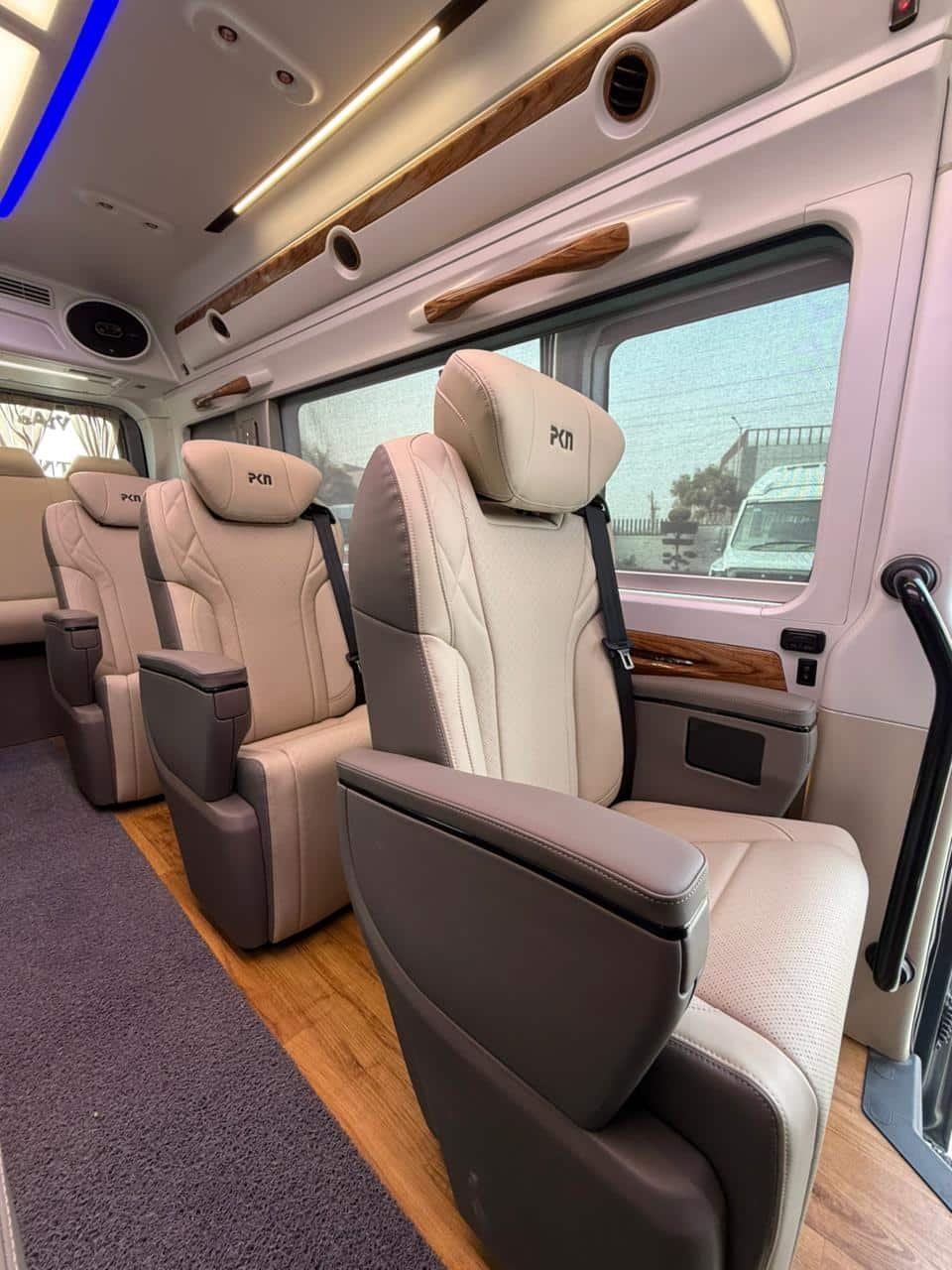
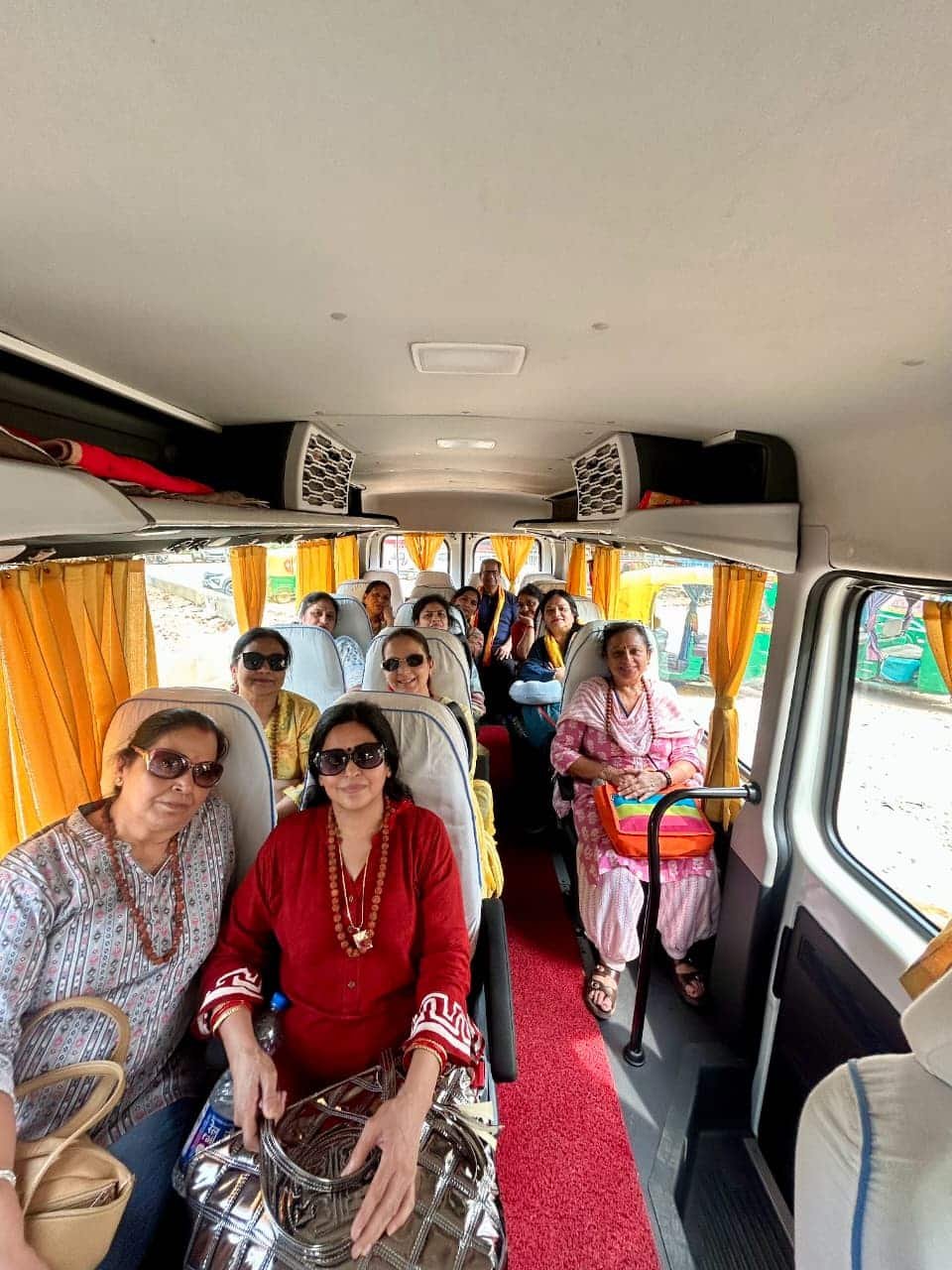
- Tall cabin with ambient/mood lighting — most adults can walk the aisle upright, which matters with elderly passengers and children.
- Sliding side door — a wider opening than a standard van door, useful at temple parking areas where you cannot pull up to a kerb.
- Air conditioning with rear AC vents — the rows at the back get direct airflow rather than relying on the front unit.
- Push-back seats in most passenger layouts; Maharaja layouts add wider recliner-style seating for more legroom.
- USB charging at the front and rear and a 7-inch touchscreen with wired Android Auto/Apple CarPlay listed on current variants (fleet units vary).
- Overhead racks plus a rear luggage area — more luggage options than a typical Traveller, though a full 16-passenger load with large suitcases is still tight.
- Large windows and car-like keyless-style controls that make the van feel less like a commercial vehicle.

Force Urbania Specs, Mileage & Safety
| Spec | Value |
|---|---|
| Engine | 2,596 cc, 4-cylinder turbo diesel (FM 2.6 CR ED) |
| Power / torque | 114 bhp @ 2,950 rpm / 350 Nm @ 1,400–2,200 rpm |
| Gearbox / drive | 5-speed manual / rear-wheel drive |
| Listed highway mileage | ≈ 11 km/l (a full load with AC will usually return less) |
| Fuel tank | 70 litres → theoretical range ≈ 770 km |
| Size (17-seater) | 7,010 mm long · 2,095 mm wide · 2,550 mm high |
| Ground clearance | 200 mm (unladen) |
| Brakes | Disc brakes on all four wheels, ABS + EBD |
| Safety | Driver + passenger airbags, electronic stability control, engine immobiliser, rear parking sensors |
| Emission norm | BS VI |
The Force Urbania is listed at about 11 km/l with a 70-litre diesel tank, giving a theoretical range of around 770 km. Fuel is included in Sachin Travels’ per-km hire rate, so mileage affects our cost, not your fare.
Force Urbania vs Tempo Traveller vs Innova Crysta
| Feature | Force Urbania | Tempo Traveller | Innova Crysta |
|---|---|---|---|
| Passengers | 9–16 | 9–16 | 6–7 |
| Outstation rate (Sachin Travels) | ₹35/km | ₹25/km | ₹20/km |
| Body / chassis | Monocoque, car-like cabin | Ladder-frame | Monocoque MPV |
| Same maker as Tempo Traveller? | Yes — Force Motors | Yes — Force Motors | No — Toyota |
| Rear AC vents | Yes | Varies by unit | Yes |
| Brakes | Disc, all four wheels | Varies by unit | Varies by variant |
| Best for | Long routes, elders, premium group trips | Budget groups, shorter runs | Families of 4–7 |
The honest read: for 5–7 people take the Innova — none of this matters. For larger groups the real choice is Urbania versus Tempo Traveller. Under ~150 km with a younger group, the Traveller’s lower rate is hard to beat. Above ~150 km, or with grandparents in the group, the Urbania’s cabin tends to be worth the extra ₹10 per km.
Which Vehicle Fits Your Group? (Quick Guide)
| Group size | Recommended vehicle | Why | Outstation rate |
|---|---|---|---|
| 1–3 | Sedan (Swift Dzire) | Cheapest; easiest in old-city lanes | ₹12/km |
| 4–6 | Ertiga / Innova Crysta | Comfortable, good boot | ₹18 / ₹20/km |
| 7–9 | Tempo Traveller or Urbania (Maharaja on request) | Depends on comfort vs budget | ₹25/km · Urbania ₹35/km |
| 10–12 | Urbania 12-seater or Tempo Traveller 12 | Urbania = comfort; Tempo = lower cost | ₹35/km · ₹25/km |
| 13–16 | Urbania 17-seater or Tempo Traveller 17 | Keeps a bigger group in one vehicle | Confirm fare |
| 17+ | Mini bus or two vehicles | Best per-person for large groups | Confirm fare |
🤔 Not sure which size fits?
Send your group size, bag count and whether elderly passengers are travelling. We’ll tell you straight which vehicle fits — including when a cheaper one is the better call.
October–November 2026: Festival & Wedding Booking Guide for Group Vans
The next six weeks are the busiest stretch of Varanasi’s travel year. These are the dates that move group-vehicle demand, from the 2026 panchang calendar:
| Date (2026) | Occasion | What it means for group travel |
|---|---|---|
| 11–20 Oct | Sharad Navratri (Dussehra 20 Oct) | Pilgrim groups to Vindhyachal & Kashi temples; Ram Leela evenings |
| 29 Oct | Karwa Chauth | Short family outings |
| 6–11 Nov | Dhanteras → Diwali (8 Nov) → Bhai Dooj (11 Nov) | Family reunions, long-distance returns to Varanasi |
| 13–16 Nov | Chhath Puja | Heavy return travel across eastern UP & Bihar — big family groups, early-morning ghat visits |
| 20 Nov | Dev Uthani Ekadashi | Marks the restart of the wedding-muhurat season |
| 24 Nov | Dev Deepawali (Kartik Purnima) | One of Varanasi’s busiest nights — book early, expect vehicles to stop well short of the ghats |
If you are planning a Varanasi–Ayodhya or Varanasi–Prayagraj leg around these dates, use our Varanasi to Ayodhya distance and route guide and the Ayodhya family-trip vehicle guide before choosing a vehicle.
Force Urbania: Buy or Hire?
If you landed here searching for the Urbania’s purchase price: CarDekho’s August–September 2026 listings show on-road prices running from roughly ₹30 lakh to ₹43 lakh depending on variant and state, before the cost of a driver, permits and commercial insurance. For a single pilgrimage, wedding or group trip, chauffeur-driven hire avoids all of that. If you run regular group trips, buy-versus-hire is a business-case question — ask us what your annual kilometres would cost on hire.
Tips for a Comfortable Urbania Journey
- Seat elderly passengers near the sliding door — the easiest step in and out.
- Pack soft duffel bags for overhead racks; hard suitcases go in the rear luggage area.
- For 4–5 AM departures (Ayodhya darshan, Ganga aarti timings), confirm the pickup time and driver name the evening before.
- Save the driver’s number and the vehicle registration to your phone as soon as they are shared.
- Ask for the AC to be running a few minutes before boarding on warm afternoons.
Common mistakes when booking a group vehicle
- Counting seats wrongly. Force’s “17-seat” includes the driver — 16 passengers.
- Booking by seat count and ignoring luggage. A group of 12 with heavy bags may be happier in the 17-seater.
- Assuming per-seat pricing. Group vehicles are priced per vehicle, not per passenger.
- Booking too late for festival dates. Chhath (13–16 Nov) and Dev Deepawali (24 Nov) are the pinch points this year.
- Choosing an Urbania for a short city loop. Under ~30 km the comfort gain rarely justifies the premium.
Ready to lock your vehicle for Chhath or Dev Deepawali?
Send date, route and group size — we’ll reply with a confirmed fare and tell you honestly if a cheaper vehicle fits better.
Frequently Asked Questions
What is the Force Urbania hire rate per km in Varanasi?
How many seats does a Force Urbania have?
What is the mileage of the Force Urbania?
Is the Force Urbania better than a Tempo Traveller?
How much does a Force Urbania cost from Varanasi airport to the city?
How much does a Force Urbania cost from Varanasi to Ayodhya?
What safety features does the Force Urbania have?
Is the Force Urbania automatic or manual?
When should I book a Force Urbania for Chhath Puja and Dev Deepawali 2026?
What is the difference between a standard Urbania and a Maharaja Urbania?
How much luggage can a Force Urbania carry?
Should I buy or hire a Force Urbania?
Sources & how this page is maintained
- Vehicle specifications and variant list: CarDekho — Force Urbania specifications (checked 16 Oct 2026).
- On-road price ranges: CarDekho Urbania city price pages, August–September 2026.
- Festival dates: published 2026 panchang calendars (Diwali 8 Nov, Chhath 13–16 Nov, Dev Deepawali 24 Nov). Verify exact tithi timings on Drik Panchang before fixing travel.
- Hire fares: Sachin Travels’ own rate card, reviewed and updated by Sachin Yadav on 16 Oct 2026. Fares are reviewed every quarter and before major festivals.
- Spot an error? WhatsApp +91-8299503337 and we will correct it.
Explore More Sachin Travels Services
Tempo Traveller Hire₹25/km · Budget groups
17-Seater Tempo TravellerLarger groups
Innova Crysta Hire₹20/km · Families
Mini Bus 35-SeaterLarge yatra groups
Varanasi Airport TaxiLBS Airport · 24/7
Varanasi to Ayodhya GuideDistance, time & darshan
Varanasi Tour PackagesPilgrimage circuits
Full Vehicle FleetCompare every vehicle
A Force Urbania isn’t right for every trip — a family of six is better off in an Innova, and a short local loop doesn’t need recliner-style comfort. But for ten or more people heading four or five hours to Ayodhya or Prayagraj, especially with elders on board, it is the more comfortable choice from Force Motors’ own line-up.
📞 Questions? Call or WhatsApp +91-8299503337 — bookings open 24 hours.
